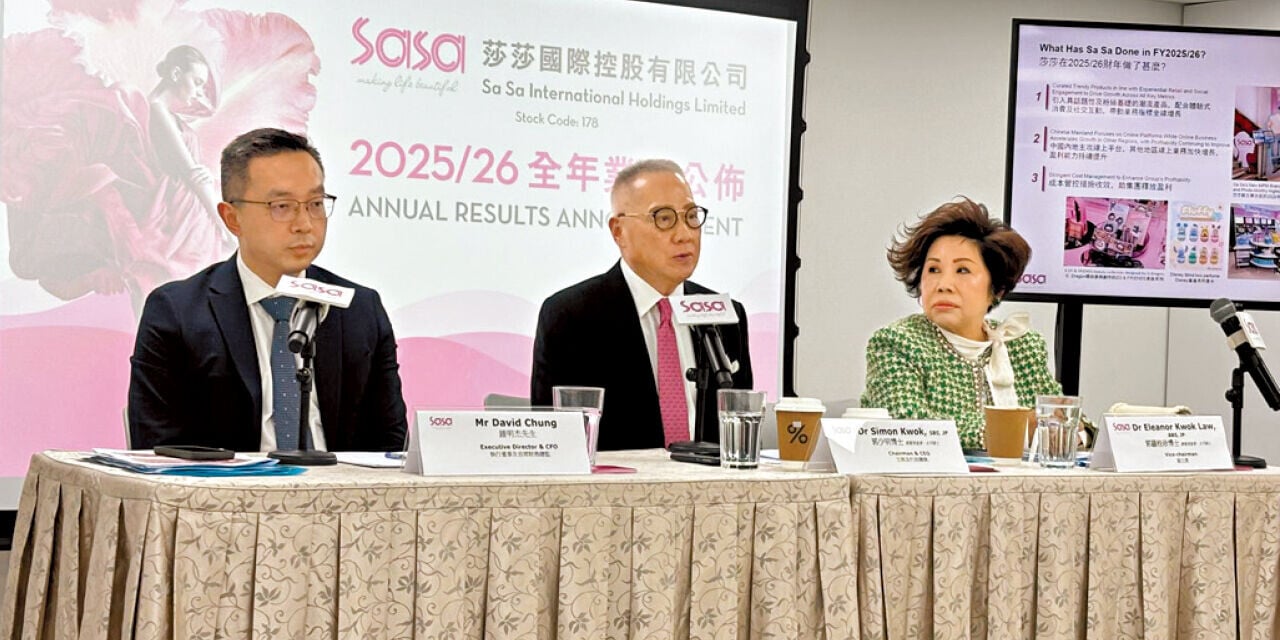
Sa Sa International Holdings Ltd. is ramping up store openings and restoring a full dividend payout after a sharp rebound in profit, underscoring management’s confidence in the recovery of Hong Kong and Macau’s beauty retail market. The cosmetics chain’s full-year sales rose 14.2% to HK$4.383 billion, while profit increased 1.6 times from a year earlier, allowing the group to boost its final dividend and return its payout ratio to 100%. Chairman and chief executive Simon Kwok said the stronger distribution reflects a “very strong” outlook, pointing to broad-based improvement in store traffic and spending.
Kwok said all key operating indicators in Hong Kong and Macau — including revenue, same-store sales, transaction volume, average ticket size and units per transaction — recorded year-on-year gains in the last financial year. Momentum has continued into the new year: in the first quarter of the current financial year, total revenue grew 24%, with offline sales up 30.9%. Hong Kong and Macau led with a 32.5% jump in offline sales, while Southeast Asia rose 17%. Online revenue slipped 3.2% overall, weighed by an 18.1% decline in mainland China, even as Hong Kong, Macau and Southeast Asia posted online growth.
On the back of the recovery, Sa Sa is reviving its brick‑and‑mortar expansion, particularly in tourist districts that were heavily rationalised during the downturn. The company plans to open 10 new stores in the current financial year; it has already added outlets in Mong Kok and Tsim Sha Tsui, including a large upstairs shop of about 6,000 to 7,000 square feet at the Mong Kok Man Wah Centre, on top of an existing ground‑floor unit. A store at the Airside mall in Kai Tak is slated to open in August, and another at Lok Ma Chau is planned to capture cross‑border traffic. Kwok said tourist‑area stores are now about half the number they once were, leaving “substantial room” to rebuild the network, though he stressed the group will not neglect local customers.
Store format will be a key part of the strategy. Kwok said he and his wife favour large outlets and that she has advocated opening flagship stores to serve both mainland and local shoppers in a more spacious, comfortable environment. Still, decisions between large and small formats will depend on rents and operating costs; smaller shops require less staff and investment. He said that while the opening of new outlets may “slightly” dilute same‑store sales metrics, the impact should be limited as long as locations and rental terms are carefully chosen. Footfall remains the main focus: “Only when there are people will there be revenue,” he said, adding that broader product assortment and competitive pricing should help underpin demand even as more drugstore and beauty chains enter the market.
Sa Sa also aims to stabilise and eventually grow its Southeast Asian operations, where the group ended the last financial year with 75 stores — 70 in Malaysia and five in Singapore. The region’s near‑term target is to achieve break‑even. Three of the five Singapore stores are already profitable, and Kwok said the company would consider opening more outlets there if suitable opportunities arise, noting that Singaporean sales growth was particularly strong in the second half of the year. The Malaysian business is described as stable, with management planning tighter cost control. Kwok played down concerns about competition from other travel destinations and cross‑border consumption trends, saying that Hong Kong remains convenient for many mainland visitors, some of whom come once or twice a month, and that the company’s breadth of products and pricing remain competitive.

L’Opéra de Paris se prépare à l’une des plus longues interruptions de l’histoire du Palais Garnier. La scène de l’édifice inauguré il y a 151 ans sera fermée de 2027 à 2032, soit cinq ans au lieu des deux initialement annoncés, en raison d’un allongement du calendrier des travaux de modernisation lié à la présence de plomb dans la cage de scène. La décision, dévoilée aux quelque 1.500 salariés puis confirmée à l’AFP par le directeur général Alexander Neef, marque un tournant pour une institution dont le vieillissement des bâtiments a été souligné par un rapport de la Cour des comptes.
Au départ, l’Opéra prévoyait un schéma alterné : deux ans de fermeture pour le Palais Garnier entre l’été 2027 et l’été 2029, puis deux ans pour l’Opéra Bastille entre mi‑2030 et mi‑2032. Le nouveau calendrier bouleverse cette organisation. Le chantier du Palais Garnier est désormais étalé sur cinq ans afin de permettre le retrait intégral du plomb dans les dessous et les dessus de scène, sous l’effet d’un renforcement de la réglementation et des exigences des organismes de prévention et de contrôle. En conséquence, les travaux de rénovation des équipements scéniques de Bastille, un temps envisagés à partir de 2030, ne démarreront qu’en 2033, pour une durée de deux ans.
L’objectif reste inchangé : moderniser en profondeur les cages de scène des deux sites, tant sur le plan scénique (machinerie) que sur celui du bâtiment (réseaux, traitement d’air, électricité). Comme dans de nombreux monuments historiques, la présence de plomb au Palais Garnier était connue et faisait déjà l’objet d’un suivi régulier, précise Alexander Neef. Le traitement de ce plomb figurait dans le projet initial, mais la nécessité désormais de le retirer intégralement dans la cage de scène prolonge considérablement l’opération et impose une première phase de chantier centrée sur ce retrait, avec son lot de nuisances, notamment bruits et vibrations.
Pour la direction, cette révision à la hausse du calendrier est assumée. « C’est un choix que nous assumons, un choix de responsabilité, un choix fait pour la pérennité de l’outil de travail », insiste Alexander Neef, qui affirme vouloir éviter d’ouvrir un nouveau chantier dans quelques années. Pendant que le Palais Garnier sera indisponible, l’Opéra de Paris maintiendra ses spectacles lyriques et chorégraphiques à l’Opéra Bastille, resté ouvert, et prévoit une programmation hors les murs dans d’autres salles de la capitale, comme le Théâtre des Champs‑Élysées, le Théâtre du Châtelet, le Théâtre de Chaillot ou le Théâtre de la Ville. La maison lyrique entre ainsi dans une longue période de transition, contrainte par des enjeux sanitaires et techniques, mais présentée comme un investissement pour la durée.



