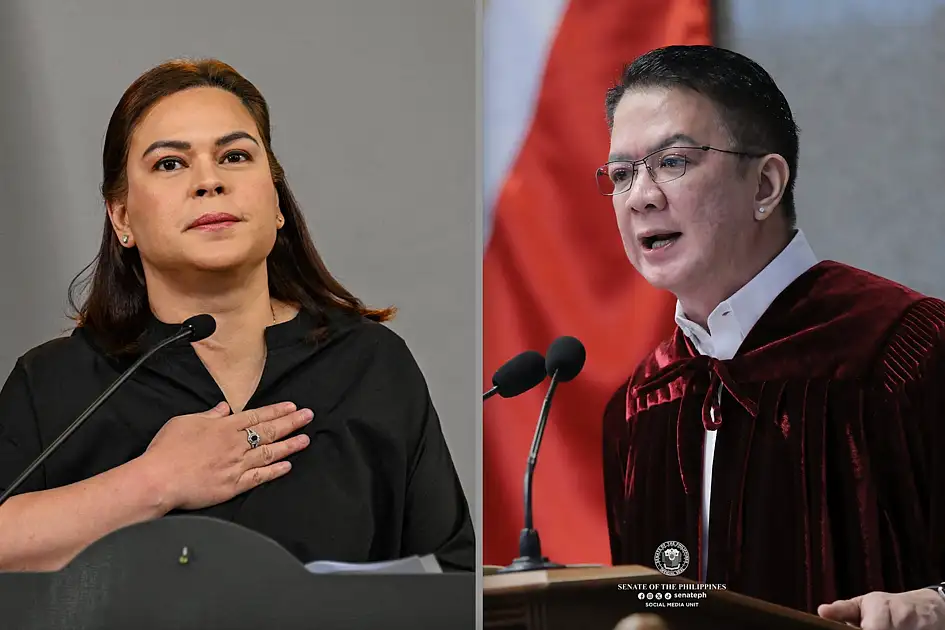
The Philippine Senate opened the impeachment trial of Vice President Sara Duterte on Monday under a cloud of procedural disputes and questions over unity in the chamber, even as Senate President Sherwin Gatchalian vowed to uphold the institution’s integrity. The trial, the first impeachment proceeding against a sitting vice president, began in the afternoon after Gatchalian used a morning flag-raising ceremony to reassure officials and staff that his leadership would be guided by integrity, professionalism, dedication and “leadership by example.” He urged the Senate bureaucracy to continue providing “quality service” despite the political strain brought by the high-stakes process.
Uncertainty continued to hang over the political optics of the trial’s opening day. Gatchalian said earlier he had yet to receive word on whether Duterte herself would appear before the Senate, sitting as an impeachment court. He also said he was “not sure” whether members of the minority bloc would boycott the proceedings, though he noted that minority senators Loren Legarda and Robinhood Padilla had already committed to participate as senator-judges. Framing attendance as a constitutional obligation, Gatchalian encouraged all 24 senators to be present, stressing that the public was waiting for the trial to start so the chamber could eventually return to its regular workload.
Once the impeachment court convened around 2 p.m., the Senate immediately became embroiled in a debate over who should wield the gavel. Gatchalian initially presided and, after his opening statement, moved for the election of a presiding officer, citing impeachment rules that he said were amended without objection during a June 3 session attended by 12 majority senators. Senate Minority Leader Alan Peter Cayetano objected, arguing that the 1987 Constitution clearly designates the Senate President as presiding officer in impeachment trials involving any official other than the President of the Philippines. Other senator-judges, including Kiko Pangilinan and Tito Sotto, countered that because the Constitution only explicitly requires the Chief Justice to preside over a presidential impeachment, Congress has leeway to define presiding arrangements through its own impeachment rules.
The dispute culminated in a vote among the senator-judges, with 12 in favor and 8 against electing Senator Chiz Escudero as presiding officer, following his nomination by Senator Panfilo Lacson. Gatchalian did not participate in the vote. The move underscored the tension between constitutional interpretation and internal Senate procedures, as lawmakers invoked Article XI, Section 3(8) of the Constitution, which empowers Congress to promulgate its own impeachment rules. Even as he ceded the gavel in the impeachment court, Gatchalian emphasized the need for the Senate to quickly balance its trial duties with pressing legislative work, including resuming investigations into a flood control budget scandal and deliberations on the proposed 2027 national budget.
Against this backdrop, Gatchalian sought to project stability and institutional resilience. Speaking to Senate employees, he thanked them for helping ensure the orderly opening of the proceedings and assured them that under his watch, the chamber would not undertake anything that would “damage the institution we all cherish.” He urged senators and staff alike to embrace the four principles he laid out for his leadership to demonstrate that the Senate remains ready to provide “the most effective service” to the country. As the Duterte impeachment trial proceeds, the chamber faces not only the legal and political questions surrounding the case itself, but also an internal test of how it interprets its own rules and navigates divisions while maintaining public confidence.

Le tribunal correctionnel de Paris a condamné six hommes, issus de la mouvance d’ultradroite pronazie, à des peines allant jusqu’à sept ans de prison pour un vaste trafic d’armes. Cinq d’entre eux, âgés de 22 à 25 ans, ont été reconnus coupables d’association de malfaiteurs terroriste, au terme d’un procès ouvert le 23 juin et clos vendredi 3 juillet après huit jours d’audience. Les juges ont retenu l’existence d’un réseau structuré gravitant autour de l’extrême droite la plus radicale, où la circulation d’armes côtoyait des projets de violences ciblées.
Selon l’enquête, ce noyau de sympathisants néonazis nourrissait des projets violents visant des juifs, des musulmans, la communauté LGBTQ+ ainsi que des militants de gauche. Parmi les cinq jeunes condamnés figurent deux anciens militaires, dont l’un a été décrit à l’audience comme le pivot du trafic. Cet ex-soldat, élevé dans un environnement marqué par l’antisémitisme et un traditionalisme catholique, a lui aussi écopé de sept ans de prison, mais sans période de sûreté, la procureure estimant qu’il avait en partie « évolué ».
La peine la plus lourde, sept ans de prison assortis d’une période de sûreté aux deux tiers et d’un suivi sociojudiciaire de six ans, a visé le plus jeune des prévenus. Né d’une mère japonaise et d’un père marocain, il a réaffirmé à l’audience son rejet du métissage, tout en expliquant avoir « délaissé certaines thèses » d’ultradroite mais en avoir « gardé d’autres ». Son attitude jugée particulièrement rigide a pesé dans la décision. Son avocate, Dominique Petit, a annoncé son intention de faire appel, ouvrant la voie à un possible second round judiciaire.
Le sixième homme, un policier retraité de 61 ans, a pour sa part été condamné à cinq ans de prison pour trafic d’armes, dont 25 mois assortis d’un sursis probatoire sur trois ans. Les magistrats ont souligné que l’enquête n’avait pas établi qu’il avait conscience d’alimenter des projets d’attentats. La partie ferme de sa peine sera purgée sous bracelet électronique. Ces condamnations, qui frappent un groupe mêlant civils, ex-militaires et ancien policier, illustrent la vigilance accrue de la justice française face aux dérives violentes de l’ultradroite radicale et à la circulation d’armes en marge des institutions.



